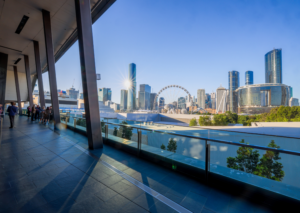

The Brisbane Convention & Exhibition Centre (BCEC) has unveiled a digital curation of its Art Collection, giving visitors and online audiences the ability to explore the works at any time via the Centre’s website and through QR codes positioned throughout the venue.
Marking the culmination of BCEC’s 30th anniversary year, the initiative reflects the Centre’s commitment as a Legends Global managed venue to sharing significant cultural assets that have shaped its story since opening in 1995.
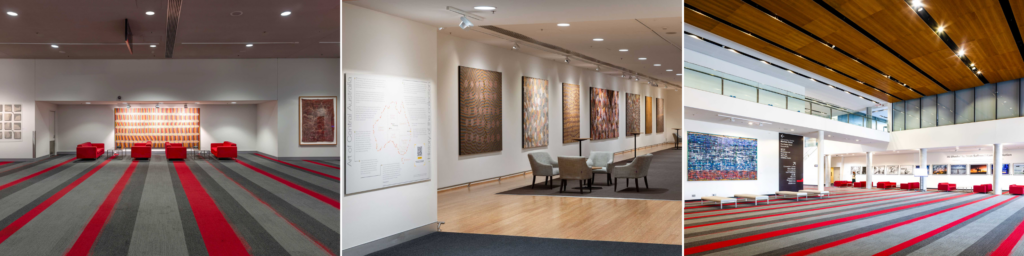
Rare for a convention and exhibition centre, BCEC is home to an extensive art collection that has become a defining feature of the venue. The initiative opens the works to a broader audience while enhancing preservation and deepening the storytelling behind each piece.
The origins of the BCEC Art Collection can be traced to Expo 88, when Creative Director John Truscott commissioned a group of Papunya Tula artworks for display in Brisbane, bringing a landmark movement in contemporary First Nations art to a broad global public audience.
That vision was sustained through the foresight of John Truscott, South Bank Corporation and Philip Bacon AO, the art dealer engaged to secure an appropriate long-term home for the artworks following Expo 88, who collectively recognised the value of retaining the Papunya works as a single collection rather than allowing them to be dispersed. Following completion of Expo 88, Mr Bacon acted as custodian on behalf of South Bank Corporation, preserving their integrity until they could be permanently housed.
As BCEC was conceived and built as part of South Bank’s post-Expo legacy, these Papunya Tula works became the foundation of the Centre’s extensive art collection, which is acknowledged as one of the most distinctive collections of Australian art outside of a major museum.
Philip Bacon AO, one of Brisbane’s and Australia’s most respected art dealers and Director of Philip Bacon Galleries, said the Papunya Tula collection remains an important and enduring cultural asset.
“These Papunya Tula paintings were an ambitious commission for Expo 1988 and amidst the many important works in the BCEC collection their preservation and placement as a coherent group respects that legacy, made more accessible through this digital initiative,” Mr Bacon said.
Anchored by the Papunya Tula works, the entire BCEC Art Collection has been curated into three categories – the Papunya Tula/Desert Art, First Nations Art, and Australian Art – reflecting the breadth of artistic practice represented throughout the Centre. Together, these works tell a distinctly Australian story through paintings, works on paper, photography and site-specific installations.
First Nations curator, writer and advisor Bruce Johnson McLean, from the Wierdi people of the Belyando River region in Central Queensland, who himself grew up in South Brisbane, led the curation and said it creates new opportunities to understand the collection’s depth, history and cultural significance.
With more than 25 years’ experience in the First Nations arts sector, Mr Johnson McLean is the Fondation Cartier pour l’art contemporain First Nations Curatorial Fellow for the 25th Biennale of Sydney and has worked as a curator, advisor and consultant across Australia and internationally.
“This collection is remarkable not only for the calibre of its artists, but for the way it traces multiple strands of Australian visual culture, from the Western Desert art movement and First Nations practice to major works by leading contemporary artists,” he said.
“Digital curation allows audiences to better understand the stories, histories and relationships embedded in the works, from the significance of the Papunya Tula artworks to the way pieces like John Olsen’s Queensland Lily Pond and Jody Rallah’s RAP commission are woven into the life of the Centre.”
Featured amongst the wider collection are major works by leading Australian artists including Gordon Bennett, Judy Watson, Dorothy Napangardi, Joe Furlonger, Jon Cattapan and Michael Johnson, alongside integrated artworks woven through the visitor journey.
BCEC General Manager Kym Guesdon said the initiative was a meaningful way to mark the conclusion of the Centre’s 30th anniversary year while broadening engagement with the collection.
“We feel very privileged to care for a collection of such cultural and artistic significance on behalf of South Bank Corporation. For visitors attending a conference or event, discovering these works as part of their time at BCEC adds a richer and more memorable dimension to their experience,” Ms Guesdon said.
“Sharing the collection digitally makes it easier for people to engage, whether they are visiting the Centre or exploring online. It is a fitting way to close our 30th year and reflects the importance we place on preserving and sharing this part of BCEC’s story.”
The digitally curated BCEC Art Collection is now available via the BCEC website, with QR codes throughout the Centre providing direct links to information as visitors move through the venue.
Media enquiries: Karyn Sutton, Communications and Marketing Manager
T: 07 3308 3022 M: +61 467 721 754 E: [email protected]